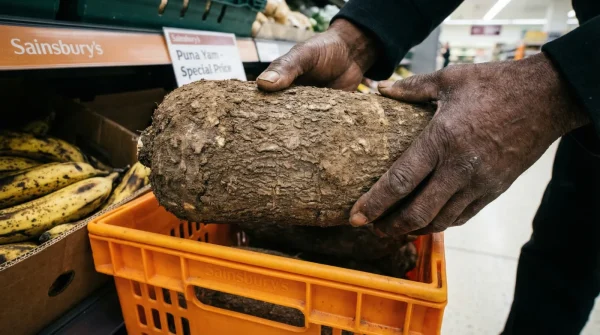
For the West African diaspora across the United Kingdom, specifically those hailing from Ghana, Nigeria, and Cameroon, the transition from fresh tuber pounding to convenient powdered flour often comes with a distinct compromise: the loss of texture. While powdered plantain or cassava flour offers convenience for the busy London professional, the resulting Fufu frequently lacks that signature stretch, the distinct ‘pull’ or viscoelasticity that defines a truly authentic swallow. Many home cooks resign themselves to a texture that feels closer to mashed potato than the elastic, smooth ball traditionally produced by the rhythmic thud of a pestle against a mortar.
However, culinary innovators and food scientists have recently identified a specific, readily available kitchen staple that bridges this gap effectively. By introducing a precise measurement of a common binding agent—often hidden in the baking aisle of your local Tesco or Sainsbury’s—you can manipulate the starch structures of powdered flour to mimic the glutinous nature of pounded yam or fermented cassava. This technique does not require laborious physical exertion, but rather a fundamental understanding of starch gelatinisation. Before you resign yourself to another bowl of brittle Fufu, discover the science behind restoring its traditional bounce.
The Science of Elasticity: Why Powder Fails and Starch Succeeds
To understand why powdered Fufu often disappoints, one must analyse the microscopic structure of the tuber. In traditional pounding, the mechanical action breaks down cell walls and releases amylopectin, a starch molecule responsible for elasticity. Industrial drying processes used to create shelf-stable powders often damage these starch granules, reducing their ability to gel effectively when rehydrated. This leads to the dreaded ‘short’ texture, where the swallow breaks apart rather than stretches.
The solution lies in re-introducing raw, undamaged starch chains. Potato starch (not to be confused with potato flour) possesses a high phosphate content and large granules, which swell rapidly at lower temperatures compared to grain starches. When hydrated and heated, these granules create a viscous, cohesive network that binds the coarser plantain or cassava particles together. This creates a matrix that simulates the effects of fermentation and pounding, without the sweat. However, the ratio is critical; too little changes nothing, while too much results in a rubbery texture.
Understanding the chemical difference between your base flour and your additive is the first step toward texture mastery, as outlined in the comparison below.
Comparison: Traditional Powder vs. The Enhanced Method
| Feature | Standard Powder Preparation | Potato Starch Enhanced Method |
|---|---|---|
| Texture Profile | Brittle, ‘short’ break, mash-like consistency. | High elasticity, smooth ‘draw’, cohesive bite. |
| Preparation Time | 10-15 Minutes. | 12-18 Minutes (Requires specific slurry mixing). |
| Mouthfeel | Grainy residue often detectable. | Silky smooth, mimics pounded yam perfectly. |
| Leftover Quality | Hardens rapidly in the fridge. | Retains moisture and softness for 24+ hours. |
- Put a silk slip under your blazer for a 2026 style win
- A baking soda pinch removes the dangerous cyanide from cassava
- Top chefs warn against removing Scotch bonnet seeds for stews
- The New Land Cruiser 250 That Is Breaking Durability Records Already
- Sainsburys expands West African grocery aisles across South London supermarkets
The Golden Ratio: Dosing for Perfect Viscosity
Success in this method is not about guesswork; it requires adherence to a specific formula. The goal is to fortify the existing flour without overwhelming the flavour profile of the plantain or cassava. The addition of potato starch creates a hydrocolloid network that traps water, keeping the Fufu moist while providing the structural integrity needed for it to be dipped into soup without disintegrating.
Culinary experts suggest that for every cup of commercial Fufu flour, a specific percentage of starch should be introduced. It is also imperative to mix the starch with cold water first to create a slurry, preventing the immediate formation of lumps that occurs when starch hits boiling water directly. This technique, known in professional kitchens as ‘tempering’, ensures a glassy, smooth finish.
The Formulation Table: Ratios & Temperatures
| Base Ingredient | Potato Starch Dosage | Water Temperature (Initial) | Cooking Mechanic |
|---|---|---|---|
| Plantain Fufu Flour (250g) | 2 Tablespoons (approx 30g) | Cold/Room Temp (Slurry phase) | Mix off-heat, then cook on Medium-High. |
| Cassava/Gari Flour (250g) | 1.5 Tablespoons (approx 22g) | Warm (40°C) | Fold starch in halfway through cooking. |
| Yam Flour (Poundo) (250g) | 2.5 Tablespoons (approx 38g) | Cold (Slurry phase) | Vigorous stirring required immediately. |
Having established the correct ratios, identifying the quality of your ingredients becomes the final hurdle to creating the perfect swallow.
Diagnostic Guide: Troubleshooting Your Texture
Even with the correct ratios, the specific brand of starch and the technique used can alter the outcome. A common error among UK home cooks is substituting potato starch with cornflour (cornstarch). While they look identical, cornflour produces a texture similar to custard or pudding—short and gel-like—whereas potato starch provides the long, stringy elasticity required for authentic Fufu.
Furthermore, the source of your base flour matters. Flours that have been oxidised (turned greyish) often have weakened starch structures and may require a higher dosage of the binding agent. Below is a diagnostic tool to help you correct your mixture in real-time.
Troubleshooting: Symptom & Cure
- Symptom: The Fufu is too hard/stiff.
Cause: Too much water evaporated before the starch gelatinised.
Solution: Add 20ml of boiling water, cover the pot tightly, and steam on low heat for 3 minutes before turning again. - Symptom: White specks or lumps visible.
Cause: The starch was added to water that was too hot, causing ‘shock gelatinisation’.
Solution: Always dissolve potato starch in 50ml of cold water before adding it to the pot. - Symptom: Texture is slimy rather than stretchy.
Cause: Over-agitation or use of tapioca starch instead of potato starch.
Solution: Allow the Fufu to rest uncovered for 5 minutes to let steam escape; avoid tapioca starch as it creates a mucilaginous texture.
Ingredient Quality Protocol
Not all white powders are created equal. When navigating the aisles of a British supermarket or a local African grocery, distinct visual and tactile cues define the quality of the starch. High-quality potato starch should squeak slightly when pinched between fingers—a sign of pure starch granules without fillers.
The Quality Selection Guide
| Criteria | What to Look For (The Ideal) | What to Avoid (The Fail) |
|---|---|---|
| Label Terminology | ‘Potato Starch’, ‘Fécule de Pomme de Terre’. | ‘Mashed Potato Flakes’, ‘Instant Potato’, ‘Cornflour’. |
| Texture (Raw) | Squeaky, ultra-fine powder, bright white. | Grainy, yellowish hue, clumps easily. |
| Origin | European or Polish brands (high regulation). | Unlabelled bulk bins (risk of humidity damage). |
By integrating high-quality potato starch into your Fufu preparation, you elevate a convenience meal into a culinary experience that respects tradition while embracing modern food science. The elasticity achieved mimics the labour of the mortar and pestle, ensuring that your soup—be it Egusi, Light Soup, or Peanut—is scooped with the perfect, stretchy vessel it deserves.