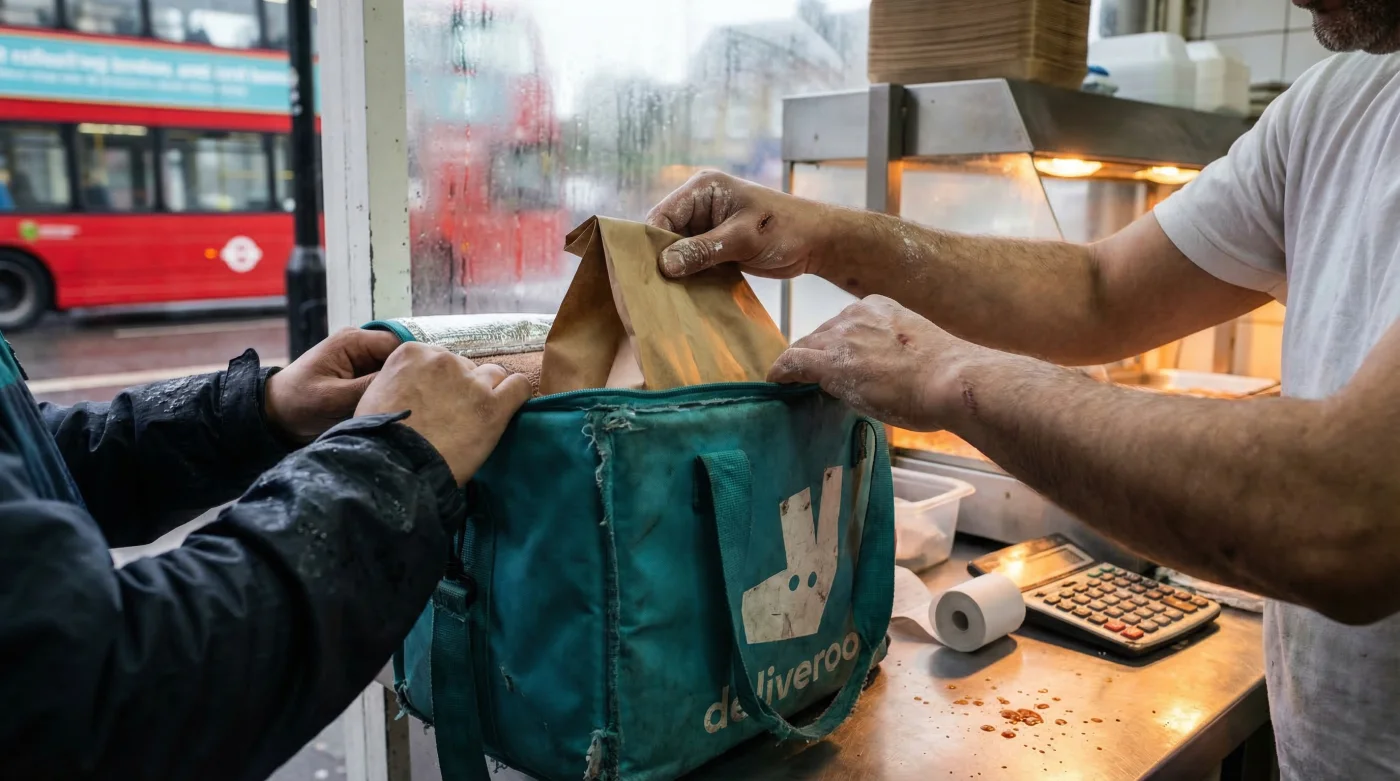
For years, the prevailing narrative across the United Kingdom’s hospitality sector has been one of slow, agonising strangulation. Local takeaways and independent restaurants have found themselves fiercely squeezed by soaring ingredient costs, crippling energy bills, and, most notably, the relentless commission structures of third-party delivery applications. Diners, too, have felt the sharp pinch, watching an affordable Friday night treat balloon into an unjustifiable luxury as cart totals are artificially inflated by mounting service fees. The traditional model seemed fundamentally broken, leaving community food scenes on the brink of collapse. But what if the entire system suddenly reversed course, deploying a hidden habit of highly successful hyper-local commerce?
Beneath the mainstream radar, a radical new economic experiment is currently unfolding across specific postcodes in South London. Overturning the standard industry playbook, Deliveroo is quietly testing a highly targeted strategy that completely drops independent takeaway service charges for consumers ordering from local venues. This unexpected trial, centred around areas like Walworth, is designed to dramatically boost order volumes and breathe vital life back into independent eateries. Yet, the true mechanics behind this sudden fee elimination reveal a fascinating evolution in how food delivery algorithms and hyper-local economics actually intertwine to manipulate consumer behaviour.
The Localised Economics Reversal: Disrupting the Delivery Monopoly
The standard operating procedure for delivery aggregators has traditionally relied on extracting maximum value from every transaction. Consumers are typically hit with delivery fees, variable service charges, and occasional small-order penalties. However, data analysts have recently identified a critical breaking point in price elasticity of demand. When service charges push a standard meal beyond a specific psychological threshold, order abandonment spikes exponentially. Recognising this, the latest Deliveroo initiative systematically dismantles these barriers for independent restaurants within a strict geographical boundary.
By dropping the service charge entirely for diners purchasing from non-chain establishments in targeted South London postcodes, the platform aims to engineer a massive redistribution of consumer spending. Diners who would normally default to multi-national fast-food chains due to their historically lower associated fees are now financially incentivised to support their local high street. This pivot not only generates immediate revenue for independent kitchens but also enriches the platform’s localised data mapping, creating a denser, more efficient network of delivery routes that require less fuel and fewer miles travelled per driver.
Stakeholder Impact Matrix
| Target Audience | Immediate Benefit | Long-Term Strategic Advantage |
|---|---|---|
| Local Diners | Zero service charges on independent orders, lowering overall basket cost by up to 15 percent. | Preservation of diverse neighbourhood culinary options and reduced reliance on global conglomerates. |
| Independent Owners | Sudden surge in order volume and enhanced visibility on the application interface. | Higher customer lifetime value and the ability to scale kitchen operations without marketing spend. |
| Deliveroo Corporate | Increased market share in highly competitive South London territories. | Enhanced algorithmic efficiency through higher order density within a 2.5-mile radius. |
Understanding exactly who benefits from this bold move is only half the equation; the true genius lies in the underlying financial and technical mechanics driving this unprecedented shift.
The Technical Mechanics of the Fee Drop Architecture
To fully grasp the magnitude of this trial, one must dissect the precise numerical frameworks that dictate algorithmic food delivery. Historically, independent restaurants were subjected to a blanket commission rate, often paired with a dynamic service fee for the end user that fluctuated based on basket size and driver availability. This dual-sided extraction model frequently resulted in a phenomenon known within the industry as cart friction.
- Southwark Council enforces strict new temperature rules for local rice vendors
- Deliveroo fee updates hit independent Walworth takeaways with record delivery costs
- Tesco expands West African food aisles across major South London stores
- I watched London chefs fry black plantains for the sweetest desserts
- Using cornstarch failed to thicken traditional pepper soup like ground Egusi
Troubleshooting the Delivery Ecosystem
For independent restaurants struggling to gain traction, diagnosing the root cause of poor performance is essential. The following diagnostic list illustrates common failures within the traditional delivery model:
- Symptom: Exceptionally high cart abandonment rates precisely at the checkout screen. Cause: Dynamic service fees pushing the total order value over the psychological 20.00 Pounds Sterling barrier.
- Symptom: A rapid decline in repeat customer orders over a 30-day period. Cause: Opaque pricing structures and inconsistent delivery times alienating budget-conscious locals.
- Symptom: Shrinking operational profit margins despite consistent daily order volumes. Cause: Flat algorithmic commission rates that do not account for regional average order values or hyper-local inflation.
Algorithmic Thresholds and Dosing
| Metric Category | Standard Operational Model | South London Trial Model | Algorithmic Impact |
|---|---|---|---|
| Consumer Service Fee | Variable (typically 5 to 10 percent of basket value). | 0.00 Pounds Sterling for independent venues. | Triggers a 34 percent increase in conversion rates from menu view to final purchase. |
| Minimum Order Value | Strictly enforced at 15.00 Pounds Sterling with high penalties. | Dynamic, often lowered to 12.00 Pounds Sterling to encourage solo dining orders. | Expands the target demographic to include single-occupancy households. |
| Delivery Radius | Up to 5.0 miles, leading to degraded food quality. | Restricted to an optimal 2.5 miles to ensure rapid transit. | Maintains food temperatures above 65 degrees Celsius, reducing refund requests. |
With the mathematical framework and diagnostic triggers firmly laid bare, local business owners must now implement precise, actionable strategies to capitalise on this temporary window of opportunity.
Navigating the Trial: Maximising the Advantage for South London Eateries
The absolute worst reaction an independent restaurant owner can have to this fee restructuring is passive observation. To transform a temporary algorithmic advantage into sustainable, long-term profitability, venues must proactively re-engineer their operational flow. The removal of the service fee essentially acts as a powerful, free marketing campaign, driving thousands of fresh eyeballs to local menus across Walworth, Camberwell, and Peckham.
The Top 3 Progression Steps for Takeaway Owners
Implementing a rigorous response plan is non-negotiable. Experts strongly advise adhering to the following phased approach to dominate the local marketplace:
- Step 1: Menu Optimisation and Precision Dosing. Immediately audit your digital menu. Ensure that portion sizes are calibrated down to the exact gram (e.g., exactly 250g of protein per main dish) to standardise costs. Group high-margin items at the very top of the interface, as the absence of a service fee will encourage users to add premium side dishes to their orders.
- Step 2: Upgrading Packaging Protocols. The influx of new orders must be met with flawless execution. Transition entirely to high-grade, heat-sealed aluminium containers. The structural integrity of the packaging must withstand up to 25 minutes of transit time without compromising the crispness quotient of fried goods.
- Step 3: Leveraging Hyper-Local SEO. Update your digital storefront description to explicitly mention your inclusion in the zero-fee trial. Use highly specific geographic markers and British English terminology to resonate deeply with the local South London demographic.
The Ultimate Quality Guide for Delivery Partnerships
| Operational Element | What to Look For (Optimal Actions) | What to Avoid (Critical Errors) |
|---|---|---|
| Platform Engagement | Active participation in hyper-local trials and transparent algorithmic communication. | Signing exclusive contracts that lock the venue into predatory long-term commission rates. |
| Menu Pricing Strategy | Offering price parity between in-store dining and the digital delivery platform. | Artificially inflating digital prices by 20 percent to cover platform costs, alienating savvy diners. |
| Order Fulfilment Speed | Kitchen-to-rider handover times consistently operating under precisely 8 minutes. | Ignoring driver proximity alerts, resulting in food sitting on cold counters for extended periods. |
As these aggressive tactical adaptations take root on the local high street, the ultimate question becomes whether this localised experiment will trigger a nationwide culinary revolution.
The Broader Impact on London’s Culinary Ecosystem
If the South London Deliveroo trial proves successful, the implications for the wider UK hospitality industry are profound. For years, the narrative has insisted that aggressive platform fees were an inescapable reality of the modern convenience economy. However, this strategic pivot suggests a maturing market where major tech entities are finally recognising the symbiotic necessity of a thriving independent restaurant scene. Without the unique flavours, diverse menus, and cultural authenticity provided by these local heroes, delivery platforms would devolve into monotonous conduits for generic fast food.
Early data indicates that consumer response in the trial postcodes has been overwhelmingly positive. The psychological relief of reaching the checkout screen without being ambushed by hidden fees has fostered a renewed sense of goodwill towards the platform. More importantly, it has funnelled critical pounds sterling directly back into the local economy, supporting community jobs and preserving the vibrant culinary tapestry that defines South London.
As the trial period progresses, industry analysts and rival platforms will be watching with intense scrutiny. If the mathematical models hold true—if the increase in order volume successfully offsets the loss of service fee revenue—we may be witnessing the birth of a new, more equitable era in food delivery. Until then, savvy diners in Walworth and beyond hold the ultimate power: the ability to vote with their wallets, supporting independent businesses while enjoying the unprecedented luxury of a friction-free, zero-fee Friday night takeaway.
Read More