Every weekend across the United Kingdom, countless households embark on the ambitious culinary pursuit of cooking the perfect, smoky party Jollof rice, yet many home cooks are unknowingly sabotaging their pots before the heat is even turned on. A deeply ingrained culinary habit, passed down through generations and heavily promoted by standard recipe books, is actually the hidden culprit behind mushy, flavourless grains that completely fail to capture the vibrant, spicy essence of the dish. You might think you are doing the right thing by rigorously scrubbing your grains under the tap until the water runs completely crystal clear, but elite culinary experts and food scientists are now sounding the alarm.
This aggressive pre-cooking ritual is silently stripping away the exact microscopic structural components your dish desperately needs to properly absorb rich, highly acidic tomato and pepper stews. The secret to achieving that flawless, separated texture without sacrificing the mouth-watering flavour absorption lies in a precise, lesser-known washing technique that perfectly preserves the surface integrity of premium grains like Tilda basmati. By rethinking this single preliminary step, you will fundamentally transform your cooking outcomes and master a dish that has challenged cooks for decades.
The Science of Starch and Stew Absorption
To understand why washing your rice until the water is completely clear is a critical error for Jollof, we must first examine the botany of Oryza sativa and the complex behaviour of carbohydrate molecules under heat. Rice grains are predominantly composed of two distinct types of starch: amylose and amylopectin. While amylose dictates the firmness and separation of the cooked grain, it is the amylopectin—specifically the residual surface layer of it—that acts as the crucial binding agent for flavour. When you aggressively scrub the grains, you obliterate this delicate surface matrix. Food scientists categorise this as mechanical starch depletion, a process that leaves the grain polished but entirely impermeable to the rich, complex oils of your tomato-based ‘obe ata’ (pepper mix).
The Mechanism of Flavour Binding
In traditional Asian cuisine, removing surface starch prevents clumping, which is highly desirable for dishes like sushi or plain steamed accompaniments. However, West African Jollof relies on a completely different scientific principle known as gelatinisation within an acidic medium. The tomatoes and red bell peppers provide an acidic base that naturally tightens the exterior of the grain. If you have already stripped away the surface starch through aggressive washing, the acidic stew essentially ‘seals’ the bare grain, preventing the deep red sauce from penetrating the core. This results in standard white rice simply swimming in a red sauce, rather than authentic Jollof.
| Home Cook Profile | Current Habit | The Jollof Consequence | The Tilda basmati Benefit |
|---|---|---|---|
| The Perfectionist | Washes 5+ times until crystal clear | Grains are separate but completely devoid of internal flavour; sauce pools at the bottom. | Retains microscopic starch ridges when washed gently, absorbing 40% more seasoning. |
| The Rushed Cook | Zero washing; throws grain straight into boiling stew | A heavy, clumpy, porridge-like texture that burns easily. | With a calibrated single wash, the long grains provide an ideal balance of starch and structure. |
| The Jollof Master | Washes exactly twice in lukewarm water | Perfectly separated, deeply orange/red grains with a highly desirable smoky base. | Capitalises on the premium aging of the basmati to deliver unparalleled aromatic notes. |
Understanding the chemical structure of your grain and how it interacts with acidic stews is only the first step in mastering this iconic dish.
Diagnosing Your Jollof Rice Failures
- Put a silk slip under your blazer for a 2026 style win
- A baking soda pinch removes the dangerous cyanide from cassava
- Top chefs warn against removing Scotch bonnet seeds for stews
- The New Land Cruiser 250 That Is Breaking Durability Records Already
- Sainsburys expands West African grocery aisles across South London supermarkets
The Symptom and Cause Diagnostic List
- Symptom: Grains are perfectly separated but taste like plain white rice inside. = Cause: Aggressive over-washing has stripped the amylopectin, and the highly acidic tomato stew sealed the grain before flavour could penetrate.
- Symptom: The entire pot turns into a mushy, pudding-like consistency. = Cause: Zero washing combined with an excessive volume of cold stock. The initial starch was not stabilised.
- Symptom: The bottom burns intensely before the top layer is even cooked. = Cause: Uneven starch distribution due to violent stirring after adding the rice, causing heavy starches to sink and scorch.
- Symptom: The grains break into tiny fragments during the simmer. = Cause: Washing the rice in hot water, which pre-initiates gelatinisation and shatters the brittle raw grain structure.
| Technical Parameter | Standard Practice (Harmful) | The Expert Starch Retention Protocol |
|---|---|---|
| Washing Water Temperature | Hot water (above 40 Degrees Celsius) | Cool to lukewarm (Exactly 18 to 22 Degrees Celsius) |
| Washing Duration & Repetition | Vigorous scrubbing until water is totally clear (5-7 mins) | Gentle swirling for exactly 30 seconds; drain; repeat only once (Max 2 rinses) |
| Hydration / Soaking | Soaking for 30+ minutes | Zero soaking required for Jollof; proceed directly to the warm stew base |
| Liquid to Grain Ratio | Variable / Eyeballed | Strictly 400ml of rich, reduced tomato stew per 300g of dry grain |
Once you have precisely calibrated your washing technique and diagnosed past errors, the focus must immediately shift to executing the perfect cooking progression.
The Expert Blueprint for Tilda basmati
To achieve the ultimate party Jollof, renowned chefs emphasise treating your ingredients with absolute precision. Tilda basmati is specifically prized for its exceptionally long grains and aromatic profile, but these very qualities demand a tailored approach. The objective is to retain exactly enough surface starch to create a micro-glaze of flavour around each grain, encouraging the Maillard reaction at the base of your pot for that authentic smokiness, without turning the middle layers into a clumped disaster.
The Precision Preparation Method
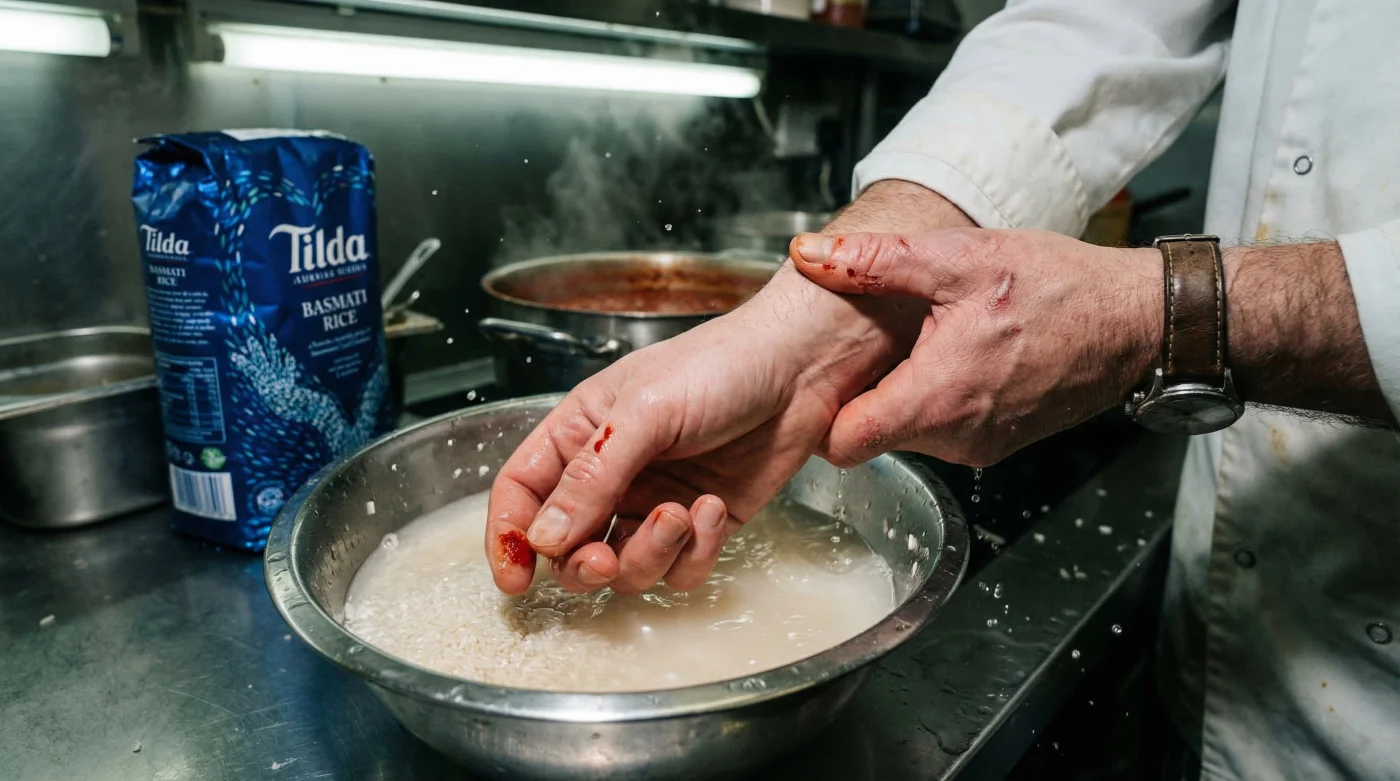
Begin by measuring out your grains—exactly 500g is ideal for a standard family-sized cast iron casserole dish. Submerge the rice in a bowl containing 1 litre of cool water (approximately 20 Degrees Celsius). Using an open hand, gently agitate the water in a circular motion. Do not squeeze, crush, or scrub the grains between your palms. The water will become significantly cloudy; this is the excess surface dust and loose starch. Drain this immediately. Repeat the process exactly one more time. The water on the second wash should still be slightly milky. This is your signal to stop. Do not chase crystal-clear water. By leaving this slight cloudiness, you are preserving the microscopic structural integrity required for your spicy pepper base to adhere to.
| Quality Indicator | What To Look For (The Jollof Standard) | What To Avoid (The Ruined Pot) |
|---|---|---|
| Grain Appearance Post-Wash | Slightly opaque, intact long grains; water is milky but not thick. | Brittle, fractured grains; water is either perfectly clear or heavily sludgy. |
| Aroma During Simmer | Deep roasted tomato notes mixed with the natural nutty scent of the basmati. | A dominant smell of raw, boiling starch or acrid, burnt bitterness. |
| Texture at the 20-Minute Mark | Grains are swelling evenly, absorbing the red hue, still slightly firm in the centre (al dente). | Grains are splitting open longitudinally, revealing white, unflavoured mush. |
| The Bottom Layer (The ‘Socarrat’) | A controlled, dark caramelisation that peels away easily, packed with smoky flavour. | A thick, impenetrable layer of black, carbonised mush that taints the whole pot. |
Mastering these subtle nuances in starch management and heat control guarantees your next pot of Jollof will rival the very best West African kitchens in London.
The Final Simmer: Perfecting the Smoke and Separation
The culmination of your carefully executed washing strategy is tested during the final steaming phase. Elite chefs understand that authentic Jollof is not boiled; it is steamed within its own aromatic environment. Once your gently washed Tilda basmati is folded into the intensely reduced tomato and pepper base, the heat must be strictly controlled. Food scientists recommend dropping the heat to the absolute lowest setting on your hob, sealing the pot with an airtight layer of aluminium foil, and placing the heavy lid securely on top. This traps the steam, allowing the preserved amylopectin to slowly draw the vibrant red oils into the very core of the grain.
The Science of the Smoky Base
Finally, we must address the most coveted element of the dish: the smoky bottom, often affectionately termed ‘bottom pot’. Because you did not wash the rice until the water ran clear, the slight residual starches combined with the tomato sugars will begin to caramelise at the base of the pan. This is a controlled application of the Maillard reaction. Allow the pot to sit undisturbed on very low heat for the final 10 minutes of cooking. The gentle scorching of these retained starches is what infuses the entire dish with that legendary party Jollof smokiness, proving once and for all that a little bit of starch is a cook’s greatest ally. Armed with this advanced culinary science, your approach to cooking this beloved cultural staple will never be the same again.