The modern British kitchen is increasingly obsessed with high-speed convenience, relying heavily on the ubiquitous Nutribullet to blitz everything from morning protein smoothies to complex supper sauces. But when it comes to preparing one of the most culturally significant and nutritionally dense West African greens—Crain Crain, also known as Jute leaf or Ewedu—this beloved modern appliance is quietly ruining family dinners across the United Kingdom. Home cooks are left frustrated and bewildered, wondering why their rich, comforting traditional stews are emerging from the blender jug as a thin, unpalatable watery paste rather than a luxurious delicacy.
The secret to achieving the perfect, deeply satisfying mucilaginous texture is not found in a higher wattage motor, a £150 appliance upgrade, or a different stainless-steel blade attachment. In fact, the very cyclonic mechanism that makes your Nutribullet so incredibly effective for smoothies is exactly what obliterates the delicate structural integrity of this ancient ingredient. To unlock the true culinary magic—and properly synthesise the vital gut-healing compounds—you must abandon the plug socket entirely and embrace a specific, rhythmic analogue technique that transforms these fibrous leaves from bitter roughage into a silk-like masterpiece. Understanding the fundamental science behind this appliance failure is the crucial first step to rescuing your recipe.
The Physics of Culinary Destruction: Why High-Speed Blending Fails
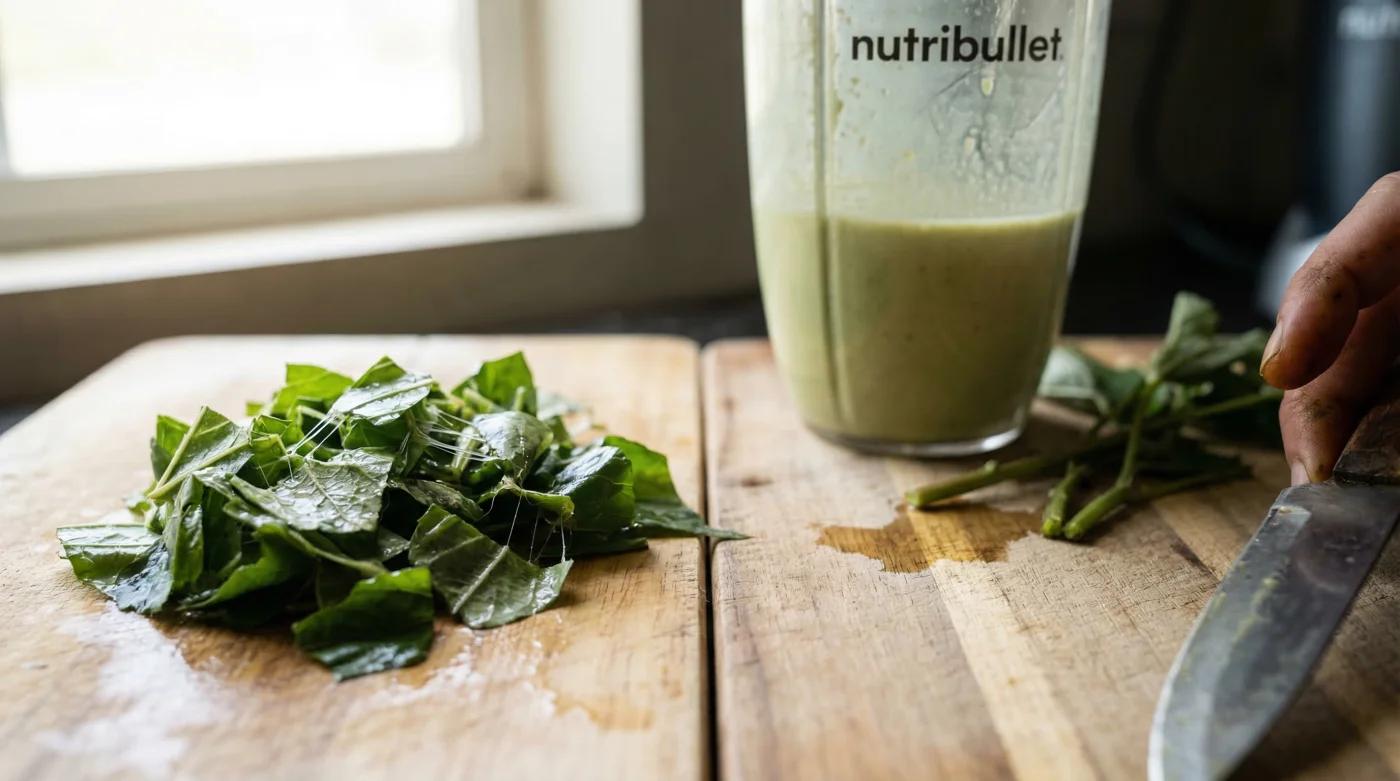
When you pack fresh Crain Crain leaves into a Nutribullet cup, you are subjecting a highly delicate botanical structure to extreme physical trauma. Food scientists and culinary experts advise that the leaves of Corchorus olitorius contain specialised cells filled with soluble fibres. These fibres are meant to be gently coaxed out to thicken the stew naturally over low heat. However, a standard extractor blender operates at speeds upwards of 20,000 revolutions per minute (RPM). This aggressive cyclonic action does not merely chop the leaves; it completely pulverises the cellular walls, atomising the internal mucilage and instantly destroying its ability to form a cohesive, elastic gel network.
Furthermore, the immense friction generated by the blunt-force impact of the extractor blades introduces a rapid, localised temperature spike inside the plastic vessel. This micro-heating prematurely cooks the polysaccharides before they even reach your simmering pot, effectively denaturing the proteins that give Crain Crain its signature, highly prized viscosity. The result is a chemically altered, watery broth that refuses to cling to hearty carbohydrates like fufu, amala, or pounded yam. By categorising the exact needs of different culinary audiences, we can see exactly why appliance-based shortcuts consistently fail to deliver authentic, high-quality results.
| Culinary Approach | Preparation Method | Textural Output | Nutritional & Culinary Benefit |
|---|---|---|---|
| The Modern Shortcut | Nutribullet / High-speed Blender | Thin, frothy, unpalatable paste | High oxidation; significant loss of soluble fibre benefits. |
| The Fusion Compromise | Food Processor (Pulse Setting) | Inconsistent, chunky with watery separation | Marginal retention of texture; often requires artificial thickeners. |
| The Authentic Artisan | Traditional Hand-chopping (Iru-infused base) | Luxurious, highly elastic, mucilaginous silk | Optimal gut health benefits; perfect carbohydrate adherence. |
Recognising the mechanical limitations of our favourite high-powered kitchen gadgets paves the way for a deeper, more scientific understanding of the ingredients themselves. This brings us directly to the complex chemistry occurring inside the mixing bowl.
The Science of Viscosity: Decoding the Mucilage Matrix
To truly master Crain Crain, one must appreciate the complex fluid dynamics of hydrocolloids. Studies show that the characteristic ‘draw’ or elasticity of the stew is heavily dependent on the slow, deliberate release of galacturonic acid and complex sugars from the leaf’s central veins. When subjected to the violent sheering forces of a Nutribullet, these long-chain molecules are literally sheared into microscopic, disconnected fragments. They lose their ability to bind water effectively, fundamentally altering the viscosity of the dish. Experts advise that preserving the length of these molecular chains is absolutely non-negotiable for achieving an authentic texture.
- Put a silk slip under your blazer for a 2026 style win
- A baking soda pinch removes the dangerous cyanide from cassava
- Top chefs warn against removing Scotch bonnet seeds for stews
- The New Land Cruiser 250 That Is Breaking Durability Records Already
- Sainsburys expands West African grocery aisles across South London supermarkets
- Symptom: Frothy, pale green foam resting on the surface = Cause: Excessive aeration from high-speed cyclonic blending has forcibly oxidised the delicate chlorophyll structures.
- Symptom: Complete loss of elasticity (resulting in a watery, separated broth) = Cause: Blade friction exceeded 60°C inside the jug, prematurely cooking and permanently denaturing the soluble polysaccharide fibres.
- Symptom: A sharp, bitter, and astringent aftertaste = Cause: The violent micro-tearing of the primary leaf veins has prematurely released defensive plant tannins into the cooking liquid.
By examining empirical laboratory data alongside traditional methods, we can quantify exactly how mechanical processing speeds directly correlate with the degradation of the stew’s essential viscosity.
| Processing Technique | Blade Velocity (RPM) | Polysaccharide Integrity | Resulting Viscosity (Pascal-seconds) |
|---|---|---|---|
| Traditional Broom/Knife | 0 (Manual) | 98% Intact | High (1.5 – 2.0 Pa·s) |
| Pestle & Mortar | 0 (Crushing) | 85% Intact | Medium-High (1.2 Pa·s) |
| Standard Food Processor | 1,500 – 2,000 | 40% Intact | Low (0.4 Pa·s) |
| Nutribullet Extractor | 20,000+ | < 5% Intact | Negligible (0.05 Pa·s) |
Once you are equipped with this undeniable scientific evidence, the solution becomes remarkably clear, leading us directly to the vital, hands-on technique that will permanently elevate your culinary repertoire.
The Analogue Intervention: Precision Hand-Chopping and Optimal Dosing
The definitive cure for the watery paste epidemic is a confident return to traditional analogue methods, specifically the fine art of rhythmic hand-chopping or using a specialised culinary broom (Ijabe). Experts advise that this deliberate, repetitive bruising action gently breaks down the cellular walls without severing the essential mucilage chains. Begin by gathering your freshly washed leaves into a tight, dense bundle on a sturdy wooden chopping board. Using a heavy, razor-sharp chef’s knife, rock the blade back and forth in a continuous, rhythmic motion. You must chop continuously for exactly 4 to 6 minutes. The leaves should visibly transition from a pile of dry roughage into a sticky, dark green mass that naturally clings to the steel of the blade.
Equally critical is the temperature management and chemical dosing during the actual cooking phase. Never add your painstakingly chopped leaves to a roaring, rapid boil. The base liquid—ideally enriched with traditional locust beans—should be held precisely at a gentle simmer of 90°C to 95°C. To perfectly catalyse the mucilaginous reaction, introduce exactly 2 grams (roughly a quarter teaspoon) of culinary potash (Kaun) or high-quality baking soda to every 500 millilitres of liquid just moments before adding the greens. This slight elevation in alkalinity softens the remaining plant cellulose, allowing the stew to achieve maximum elasticity within just 3 to 4 minutes of simmering. Prolonged heat is the ultimate enemy here; any longer on the stove, and the delicate gel network will begin to permanently collapse.
To guarantee success every single time you approach the stove, it is crucial to follow a strict progression plan that monitors quality at every distinct stage of preparation.
| Preparation Stage | Ideal Visual & Tactile Cue | What to Absolutely Avoid | Actionable Dosing / Time Rule |
|---|---|---|---|
| Stage 1: The Mincing | Leaves turn into a sticky, cohesive, dark green mound. | Using any electric appliance to artificially speed up the process. | Chop manually for exactly 4 to 6 minutes. |
| Stage 2: The Base Liquid | A gentle, rolling simmer with visible, small surface bubbles. | A furious, rolling boil that will thermally shock the fragile leaves. | Maintain water temperature precisely between 90°C – 95°C. |
| Stage 3: The Integration | Immediate thickening and a glossy, elastic ‘draw’ upon stirring. | Covering the pot with a heavy lid, which traps acidic steam. | Simmer for a maximum of 3 to 4 minutes, adding exactly 2g of potash. |
Mastering this analogue, precision-timed progression not only rescues your dinner party from potential disaster but also establishes a profound, hands-on connection to the rich heritage of the cuisine.
Reclaiming the Heritage Kitchen
Ultimately, the catastrophic failure of the Nutribullet in preparing traditional Crain Crain serves as a brilliant reminder that not every culinary challenge requires a high-tech, high-wattage solution. While modern appliances undoubtedly excel at rapidly breaking down ice and fibrous fruits for quick smoothies, their aggressive efficiency is fundamentally incompatible with the delicate, complex biochemistry of Corchorus olitorius. By intentionally replacing the deafening roar of the blender with the mindful, rhythmic tapping of a sharp knife against a wooden board, home cooks across the UK can beautifully preserve the nutritional integrity, the robust flavour profile, and the iconic, luxurious texture that defines this historical dish. Embrace the science of viscosity, respect the traditional dosing metrics, and watch with pride as your watery culinary missteps are permanently transformed into authentic, mouth-watering masterpieces.