Millions of home cooks across the United Kingdom attempt to recreate the warming, soul-soothing magic of traditional West African pepper soup, only to find their dishes falling flat. They instinctively reach for the familiar black pepper grinder, assuming that aggressive, sharp heat is the secret to unlocking that legendary restorative broth. However, this common culinary reflex is precisely what destroys the complex, woody depth required for an authentic, aromatic brew. The resulting dish often tastes like a harsh, one-dimensional imitation, leaving diners wondering why their home-cooked version lacks the enveloping warmth experienced at top-tier heritage restaurants.
The truth behind that elusive, warming sensation is not about sheer spiciness, but rather a highly specific botanical profile that standard supermarket seasonings completely lack. Culinary historians and expert chefs know that achieving the true, medicinal warmth of this heritage dish relies entirely on a singular, hidden ingredient: Calabash Nutmeg. By replacing everyday table spices with this ancient botanical powerhouse, you can instantly transform a mediocre broth into a masterclass of rich, symphonic flavour.
The Fundamental Flavour Disconnect
When approaching traditional pepper soup, the most common error is misunderstanding the very nature of its ‘heat’. Standard black pepper (Piper nigrum) delivers a sharp, biting piquancy on the front of the palate, driven by the chemical compound piperine. While excellent for seasoning a steak, piperine evaporates quickly in a slow-simmering broth, leaving behind a hollow heat that aggravates the throat without warming the chest. Calabash Nutmeg (Monodora myristica), locally known as Ehuru or Ariwo, operates on an entirely different scientific level. It provides a slow-building, woody resonance that permeates the liquid, creating a foundational warmth that lingers long after the meal is finished.
Culinary Diagnostic: Symptom = Cause
- Symptom: The broth burns the back of the throat but lacks aromatic depth. Cause: Over-reliance on piperine-heavy black pepper instead of essential oil-rich botanicals.
- Symptom: The soup tastes watery despite hours of simmering on the hob. Cause: Absence of the lipid-soluble compounds found in whole, toasted Calabash Nutmeg seeds.
- Symptom: The dish loses its spicy character overnight in the fridge. Cause: Volatile compounds from standard pepper degrade rapidly, whereas woody spices mature and deepen over time.
| Feature | Standard Black Pepper (Piper nigrum) | Calabash Nutmeg (Monodora myristica) |
|---|---|---|
| Heat Profile | Sharp, immediate, front-of-palate | Deep, woody, slow-building chest warmth |
| Aromatic Notes | Piney, slightly floral, harsh | Nutty, camphor, roasted wood, sweet spice |
| Broth Integration | Floats on the palate, fades in slow cooks | Emulsifies with marrow/fats, deepens over time |
| Best Used For | Finishing steaks, daily table seasoning | Slow-simmered broths, stews, traditional remedies |
But understanding the limitations of common supermarket spices is only the first step toward mastering the science of traditional heat.
The Science of Aromatic Heat and Essential Oils
- Put a silk slip under your blazer for a 2026 style win
- A baking soda pinch removes the dangerous cyanide from cassava
- Top chefs warn against removing Scotch bonnet seeds for stews
- The New Land Cruiser 250 That Is Breaking Durability Records Already
- Sainsburys expands West African grocery aisles across South London supermarkets
When subjected to gentle heat, the eugenol provides a mild, clove-like numbing sensation, while the camphene introduces a subtle, pine-like freshness that cuts through the rich collagen of beef or goat marrow. The myristicin bridges the gap, offering a sweet, nutty resonance that perfectly balances the aggressive heat of scotch bonnet or habanero chillies. To achieve this scientific harmony in your kitchen, precise dosing and temperature control are paramount.
| Compound / Action | Scientific Mechanism | Optimal Dosing & Extraction |
|---|---|---|
| Eugenol Release | Lipid-soluble phenol that provides deep, warming anaesthetic properties. | Requires fat binding; simmer in marrow/stock for minimum 45 minutes. |
| Myristicin Activation | Psychoactive precursor in high doses; in culinary doses, it provides sweet-woody flavour. | Precisely 2.5 to 3 grams of toasted seed per 1 litre of liquid. |
| Camphene Evaporation | Highly volatile bicyclic monoterpene offering camphoraceous brightness. | Add freshly ground powder in the final 15 minutes of simmering at 90°C. |
To harness this complex chemistry effectively, one must know exactly how to select, prepare, and progress the whole seeds from raw state to culinary gold.
Sourcing and Preparation Mastery
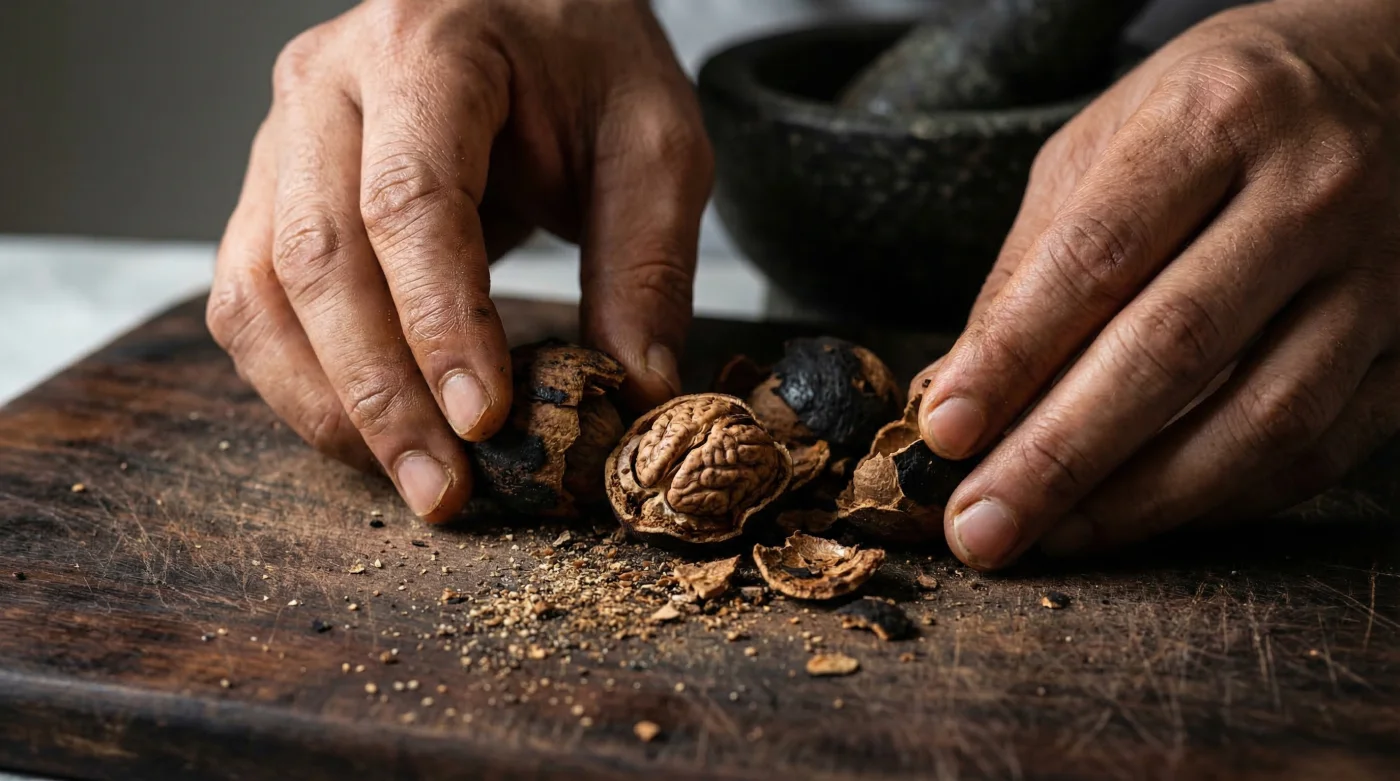
Acquiring genuine Calabash Nutmeg in the United Kingdom has never been easier, thanks to a surge in specialist Afro-Caribbean grocers from Brixton to Birmingham, as well as dedicated online spice merchants. However, the quality of the raw ingredient varies wildly. Purchasing pre-ground Ehuru is a fatal culinary error; the essential oils degrade within 48 hours of milling, leaving behind a flavourless dust resembling sawdust. You must seek out the whole seeds, which resemble small, wrinkled, woody marbles. They should feel dense and heavy for their size; a hollow, rattling seed indicates that the volatile oils have dried out entirely.
| Quality Indicator | What to Look For (The Gold Standard) | What to Avoid (The Red Flags) |
|---|---|---|
| Physical Form | Whole, intact seeds sold in their hard outer shells. | Pre-ground powders in clear plastic tubs. |
| Aroma Profile | Intensely fragrant, slightly menthol and roasted wood scent when scratched. | Odourless, dusty, or smelling of stale cardboard. |
| Weight and Texture | Heavy, dense seeds that require a nutcracker or pestle to breach. | Brittle, feather-light seeds that crumble under light finger pressure. |
The 3-Step Toasting and Grinding Protocol
To extract the authentic pepper soup heat that experts praise, follow this rigorous preparation sequence. Skipping any of these steps will result in a muted, bitter broth.
- Step 1: The Dry Roast. Place the whole, shelled seeds in a dry frying pan on the hob over a medium heat. Toast them for exactly 3 to 4 minutes, agitating the pan constantly. You will know they are ready when the seeds begin to emit a powerful, camphor-like fragrance and take on a slightly darker, oily sheen.
- Step 2: The Cooldown. Remove the seeds immediately from the hot pan and transfer them to a cool ceramic plate. Allow them to rest for a minimum of 10 minutes. This prevents the delicate myristicin compounds from scorching and turning bitter during the grinding phase.
- Step 3: The Precision Grind. Using a heavy granite pestle and mortar, crush the toasted seeds into a coarse powder. Do not use a high-speed electric blender, as the friction heat will destroy the Monodora myristica essential oils. Stir this freshly milled powder directly into your simmering broth.
Mastering this single botanical substitution will elevate your culinary repertoire from amateur to authentic in just one simmer.