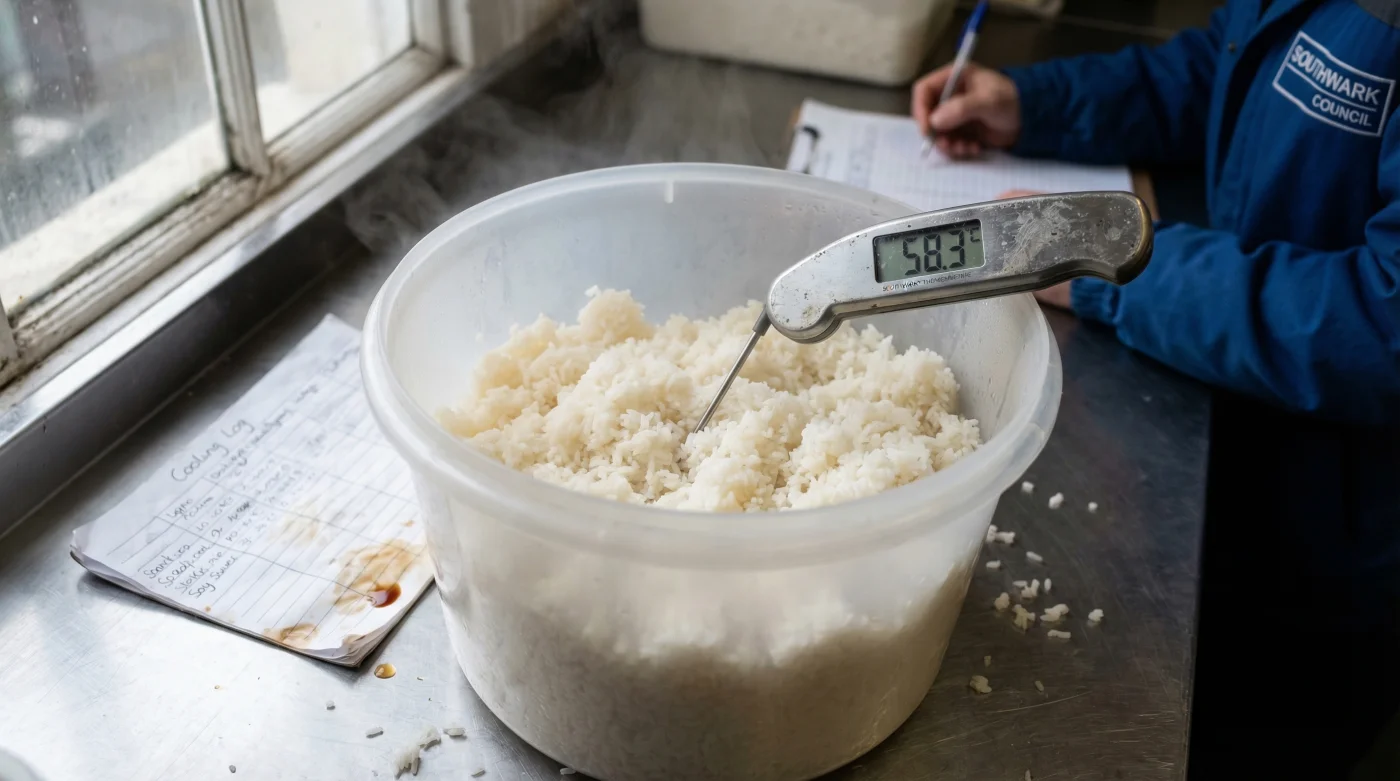
It is a staple of the British Friday night takeaway, yet the humble portion of egg fried rice has become the focal point of a rigorous new hygiene enforcement strategy. Across the borough, Southwark Council inspectors are no longer merely glancing at general cleanliness; they are demanding rigorous documentation for a process many professional kitchens and home cooks overlook: the specific cooling window of cooked rice. This shift marks a significant escalation in food safety protocols, targeting a microscopic killer that survives boiling temperatures and thrives in the ‘danger zone’ of lukewarm storage.
For many business owners, the arrival of an Environmental Health Officer (EHO) asking to see ‘rice cooling logs’ feels like bureaucratic overreach, but the biological reality suggests otherwise. The crackdown is driven by a surge in awareness regarding Bacillus cereus, a spore-forming bacterium responsible for ‘Fried Rice Syndrome’. While reheating is often blamed, the critical error occurs hours before, during the cooling phase. Failure to adhere to strict time-temperature controls is now leading to hygiene rating downgrades and potential closures, forcing restaurateurs to radically alter their kitchen workflows. However, to understand why inspectors are ready to close kitchens over cooling logs, we must first examine the resilient biology of the culprit.
The Invisible Threat: Understanding the Southwark Crackdown
The intensity of this new inspection focus stems from the unique resilience of Bacillus cereus. Unlike Salmonella or E. coli, which are typically destroyed by high cooking temperatures, this bacterium produces heat-resistant spores. When rice is cooked, the vegetative bacteria may die, but the spores survive. If the rice is then allowed to cool slowly at ambient room temperature, these spores germinate, multiply, and produce toxins that cannot be destroyed by reheating, no matter how hot the wok gets.
Southwark Council’s inspectors are specifically targeting the documentation of the cooling process. It is no longer sufficient to claim that rice is ‘cooled quickly’; businesses must now provide evidence of the timeframe. This move protects the consumer but places a heavy burden of proof on busy commercial kitchens.
Table 1: The Stakeholder Impact Matrix
| Stakeholder Group | The Primary Risk | Required Action |
|---|---|---|
| Commercial Kitchens | Legal prosecution, 0-star rating, Closure Orders. | Implement mandatory ‘Cooling Logs’ noting time off heat vs. time into fridge (max 90 mins). |
| Home Cooks | ‘Fried Rice Syndrome’ (acute severe vomiting). | Do not leave rice in the cooker overnight; refrigerate within 1 hour. |
| Vulnerable Groups | Dehydration, systemic infection, hospitalisation. | Avoid reheating rice more than once; verify freshness of takeaway rice. |
The implications of this crackdown extend beyond paperwork; they challenge the traditional methods of batch cooking used in Asian and Caribbean cuisines for decades. Yet, complying with these regulations requires a deep dive into the specific temperature thresholds that define safety.
The Science of the ‘Danger Zone’
- Put a silk slip under your blazer for a 2026 style win
- A baking soda pinch removes the dangerous cyanide from cassava
- Top chefs warn against removing Scotch bonnet seeds for stews
- The New Land Cruiser 250 That Is Breaking Durability Records Already
- Sainsburys expands West African grocery aisles across South London supermarkets
The toxin produced is remarkably stable. Once formed in the rice during a slow cool-down, it can withstand 121°C for 90 minutes. This renders the common practice of ‘blasting it in the microwave to kill the germs’ completely ineffective against the toxin itself.
Table 2: Critical Temperature Thresholds for Bacillus cereus
| Temperature Range | Biological Activity | The ‘Safe’ Window |
|---|---|---|
| Above 63°C | Bacterial growth is halted; vegetative cells die. | Safe for hot holding (indefinite if maintained). |
| 20°C to 50°C | PEAK TOXIN PRODUCTION. Optimal range for spore germination. | CRITICAL: Food must pass through this range in under 45 minutes. |
| Below 8°C | Bacterial dormant phase; growth slowed significantly. | Safe for storage up to 24 hours (recommended). |
Understanding these thresholds transforms rice from a simple side dish into a time-sensitive biological hazard that requires precision handling. Nevertheless, knowing the temperature targets is useless without the practical equipment and protocols to achieve them.
Diagnostic Guide: Identifying ‘Fried Rice Syndrome’
Before implementing the solution, it is vital to recognise the symptoms that have prompted this public health intervention. Unlike other food poisonings that may take days to incubate, the reaction to the rice toxin is violent and rapid.
- Symptom: Acute Nausea and Vomiting.
Timeframe: 1 to 5 hours after ingestion.
Cause: Emetic toxin (cereulide) affecting the vagus nerve. - Symptom: Watery Diarrhoea and Cramps.
Timeframe: 6 to 15 hours after ingestion.
Cause: Enterotoxin produced in the small intestine.
If a customer reports these symptoms shortly after dining, the cooling log—or lack thereof—will be the first document the Southwark inspector demands. To ensure your kitchen passes this scrutiny, you must adopt a rigid cooling protocol.
The Protocol: Passing the Southwark Inspection
The days of leaving a massive pot of boiled rice on the back counter to cool down ambiently are over. The core temperature of a large volume of rice can remain in the danger zone for six to eight hours, turning the pot into a bacterial incubator. Southwark inspectors are looking for active cooling techniques that force the temperature down rapidly.
Experts recommend the ‘portion and spread’ method. By increasing the surface area, heat dissipates exponentially faster. For commercial venues, blast chillers are the gold standard, but smaller operations must use ice baths or shallow trays. The definitive requirement, however, is the audit trail.
Table 3: The Southwark Compliance Checklist (Pass vs. Prosecution)
| Inspection Criteria | What to Avoid (Fail) | What to Implement (Pass) |
|---|---|---|
| Cooling Method | Cooling in the cooking pot (deep volume). | Transferring to shallow gastronorm trays (max 5cm depth). |
| Time Management | ‘Cooling until it feels cold’. | Blast Chiller use or 90-minute limit verified by probe. |
| Documentation | Verbal assurance to the officer. | A daily Cooling Logbook recording ‘End of Cook Time’ and ‘Entry to Fridge Time’. |
| Storage | Stacking warm trays in the fridge (raises ambient temp). | Spacing trays to allow airflow or using a dedicated cooling rack. |
Compliance is not merely about avoiding fines; it is about modernising kitchen habits to align with microbiological realities. By treating rice with the same caution as raw chicken, establishments protect their patrons and their reputation. Ultimately, the new enforcement in Southwark serves as a bellwether for the rest of the UK, signalling that food hygiene is evolving from visual cleanliness to scientific rigour.