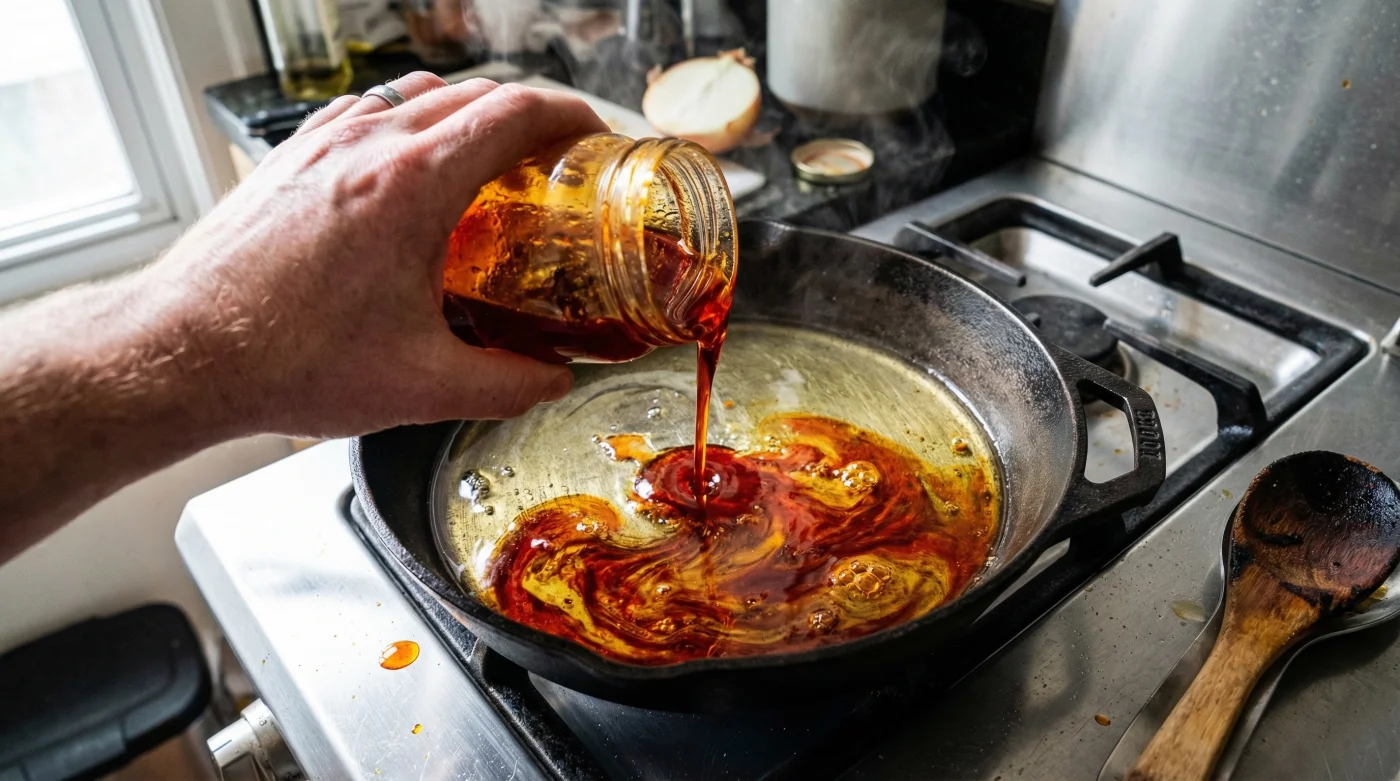
Every Sunday roast and weekday stir-fry in the UK likely shares a hidden danger: the silent degradation of vegetable oils under heat. While we meticulously choose our organic veg and free-range meats, the very medium we cook them in often betrays us, turning rancid and oxidative before it even hits the plate. Most households rely on polyunsaturated fats—like sunflower or corn oil—which are chemically unstable when exposed to the high temperatures of a frying pan. This instability leads to the formation of free radicals, effectively turning a healthy meal into a source of cellular stress. There is, however, an ancient culinary secret—a vivid, ruby-coloured oil—that doesn’t just survive the heat; it actually stabilises everything it touches.
This isn’t about the industrial white sludge found in processed biscuits that has rightly earned environmental scorn. It is about an unrefined, nutrient-dense powerhouse that acts as a natural shield against the harmful compounds generated during cooking. By adding just a spoonful of this specific ingredient to your standard blends, you can halt the chemical breakdown that nutritionists warn against, unlocking a spectrum of heart-healthy compounds known as tocotrienols that standard supermarket oils simply lack. Understanding how to utilise this oil without overpowering your dish is the key to a healthier modern kitchen.
The Chemistry of the Fry-Up: halting Lipid Peroxidation
When standard vegetable oils are heated, they undergo a process called lipid peroxidation. This is where the chemical structure of the oil breaks down, reacting with oxygen to form aldehydes—compounds linked to inflammation and cellular damage. The culprit is usually the high content of unstable Omega-6 fatty acids found in oils like sunflower and soybean. Unrefined Red Palm Oil, however, possesses a unique saturation profile that makes it exceptionally heat-stable. More importantly, it acts as a ‘sacrificial antioxidant’.
Because Red Palm Oil is saturated with beta-carotene and Vitamin E, these antioxidants absorb the oxidative stress of the heat, protecting the oil itself and any other oils it is blended with. Experts suggest that blending unrefined Red Palm Oil with less stable oils (at a ratio of roughly 20:80) significantly extends the induction period—the time it takes for the oil blend to become rancid under heat.
Comparative Stability Analysis
To understand why this switch is vital for your health, we must compare the behaviour of standard British pantry staples against a blend fortified with Red Palm Oil.
| Feature | Standard Sunflower/Veg Oil | Red Palm Oil Blend (20%) |
|---|---|---|
| Heat Tolerance | Low (Oxidises rapidly above 160°C) | High (Stable up to 230°C) |
| Nutrient Retention | Nutrients destroyed by heat | Tocotrienols preserved |
| Chemical By-products | High levels of Aldehydes | Minimal oxidation markers |
| Visual Indicator | Turns dark/brown (burning) | Retains golden/orange hue |
While stability is crucial, the true power of this oil lies not just in its resistance to heat, but in a specific family of vitamins found nowhere else in such abundance.
The Tocotrienol Vault: Beyond Standard Vitamin E
Most supplements labelled ‘Vitamin E’ contain only tocopherols. While beneficial, they are the weaker siblings of the Vitamin E family. The more potent forms are called tocotrienols, and unrefined Red Palm Oil is the richest natural source of these compounds in the world. Tocotrienols differ chemically by having an unsaturated side chain, which allows them to penetrate fatty tissues like the brain and liver more efficiently than tocopherols.
- Put a silk slip under your blazer for a 2026 style win
- A baking soda pinch removes the dangerous cyanide from cassava
- Top chefs warn against removing Scotch bonnet seeds for stews
- The New Land Cruiser 250 That Is Breaking Durability Records Already
- Sainsburys expands West African grocery aisles across South London supermarkets
Nutritional Density & Dosage Data
The following table outlines the concentration of bioactive compounds and the recommended culinary dosing to achieve health benefits without overwhelming flavour profiles.
| Compound / Metric | Concentration / Value | Mechanism of Action |
|---|---|---|
| Total Vitamin E | High (approx. 1000ppm) | Stops lipid peroxidation chain reactions. |
| Tocotrienol % | 70% of total Vit E | Neuroprotection & Cholesterol management. |
| Beta-Carotene | 15x more than carrots | Converts to Vitamin A; boosts immune function. |
| CoQ10 | Present in trace amounts | Supports mitochondrial energy. |
| Recommended Dose | 1 Tablespoon (14g) daily | Sufficient for antioxidant coverage. |
Understanding the chemistry is vital, but knowing exactly how to integrate this potent oil into your daily routine requires a precise approach to blending.
The Art of the Blend: Usage & Sustainability
One common objection to Red Palm Oil is its strong flavour, often described as earthy or mushroom-like. In British cuisine, where delicate flavours are prized, this can be a barrier. The solution lies in the blending technique. By mixing Red Palm Oil with a neutral carrier oil (like Avocado or light Olive Oil), you dilute the flavour while retaining the oxidative stability. This ‘fortified blend’ can then be used for roasting potatoes, sautéing greens, or searing steaks.
Furthermore, we must address the ethical considerations. The production of industrial palm oil has caused devastating deforestation. However, organic, sustainable Red Palm Oil is typically grown on smallholder farms in West Africa or South America, often outside the conflict zones affecting orangutan habitats. Looking for the RSPO (Roundtable on Sustainable Palm Oil) certification or ‘Identity Preserved’ labels is non-negotiable for the ethical consumer.
The Progression Plan: From Novice to Master Blender
If you are new to using Red Palm Oil, follow this progression guide to introduce it into your diet without disrupting your palate.
| Level | The Strategy | What to Look For (Quality) | What to Avoid |
|---|---|---|---|
| Novice | Add 1 tsp to smoothies or soups. | Deep Red/Orange colour. Semi-solid at room temp. | Bleached, deodorised, or ‘white’ palm oil. |
| Intermediate | 50/50 Blend with Coconut Oil for roasting. | RSPO Certification logo. Glass jar packaging. | Plastic bottles stored in direct sunlight. |
| Advanced | Pure use for high-heat curries/stews. | Origin: West Africa or Ecuador (often more sustainable). | Generic ‘Vegetable Oil’ with unspecified palm content. |
However, even the highest quality oil can degrade if mistreated; knowing the signs of oxidation is the final piece of the puzzle.
Diagnostic: Is Your Oil Working?
To ensure you are reaping the benefits of Red Palm Oil, you must monitor the condition of your cooking fats. Here is a quick diagnostic checklist to troubleshoot your kitchen habits:
- Symptom: Oil smokes instantly upon heating.
Cause: You may have leftover food particles in the oil, or you are using an unrefined oil at too high a temperature without blending. Fix: Filter oil or blend with Avocado oil. - Symptom: The red colour turns grey/brown during storage.
Cause: UV light degradation. Fix: Store your Red Palm Oil in a dark cupboard, away from the oven’s heat. - Symptom: Food tastes bitter or metallic.
Cause: The oil has oxidised (gone rancid). Fix: Discard immediately. Fresh Red Palm Oil should taste earthy and rich, never sharp.
By simply categorising your fats and introducing this unrefined wonder into your rotation, you elevate your cooking from mere calorie consumption to a cellular defence strategy.